
When asked the question, “Which do you want to hear first, the good news or the bad news?” more than 78 percent of people want to hear the bad news first, according to psychologists Angela Legg and Kate Sweeny. The explanation is simple: if they pick the good news first, they’ll likely be unable to focus because they’ll be dreading the bad news the whole time. In general, social researchers have widely found that individuals pay more attention to bad news than good news.
Psychologists say that the reason humans tend to remember negative experiences more than positive ones is negativity bias. Negativity bias is the tendency for negative information to have a stronger impact on memory and decision-making. Researchers believe this trait evolved along with us: ancient humans needed to notice threats such as predators, illness, and previous dangerous experiences to survive. An article from Psychology Today by Sam Goldstein quotes Susan Mineka, a clinical psychologist, mentioning the history behind holding on to negative information.
“Positive memories do not carry the same imperative of immediate survival. Thus, natural selection has favored cognitive systems that are ‘negativity-biased’—a phenomenon wherein organisms are more attuned to and influenced by negative stimuli,” Mineka said in the article.
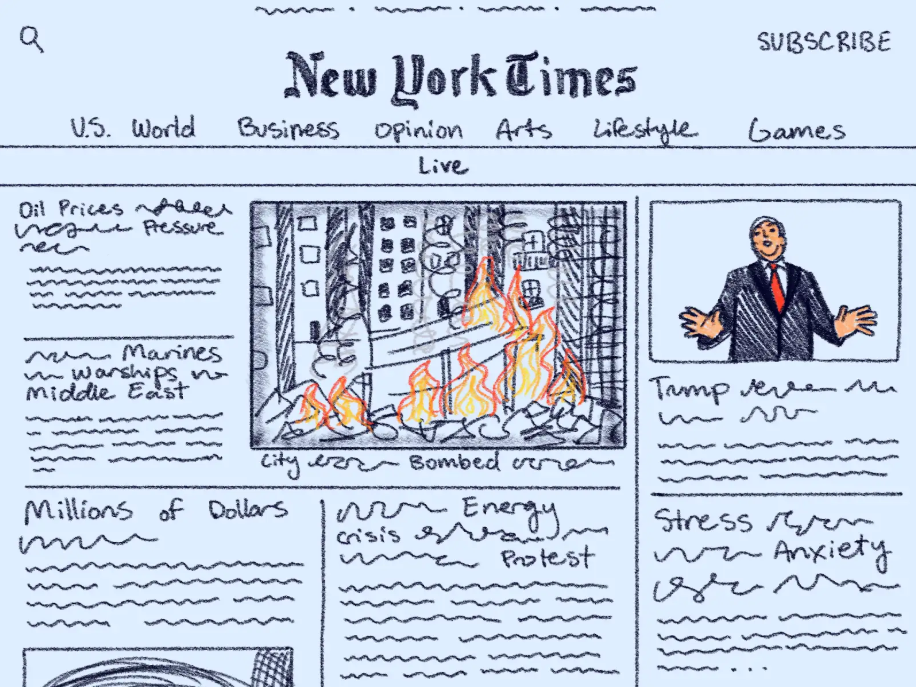
The concept of negativity bias seamlessly transfers over to the world of journalism. An article from the Washington Post revealed that negative headlines have a 60% higher click-through rate than positive ones. However, it’s not just negativity bias that causes negative headlines to receive more attention. In today’s social media-driven world, most citizens stay informed through social media rather than news websites, causing news websites to use extreme headlines to gain attention. Because of this, many publications tend to focus more on bad news than good news.
Social media’s relationship with negativity bias doesn’t end there. Apps like TikTok and Instagram encourage doomscrolling, which is the act of mindless scrolling through depressing content. An article from the American Psychological Society by Charlotte Huff included quotes from Matthew Price, a member of the Department of Psychological Science at the University of Vermont, who addressed doomscrolling.
“[Social media apps] are designed to be limitless scrolling,” Price said in the article. “When there’s a big [news-related] topic of conversation that’s negative, it can dominate what one is seeing. It can give the impression that this is the only thing that’s happening.”
While negative news tends to catch people’s attention, psychologists argue that if publications report only on the worst things happening in the world, it can create a distorted reality of what is seen compared to what’s really happening. Users may feel hopeless and overwhelmed, as if nothing positive is happening, when all they see are stories on crime, conflict, and disasters.
As people continue to get most of their news from websites and social media, understanding how negativity bias works can explain why some stories attract more attention than others. While many negative events shape our world and receive more attention because they are heavily impactful, they reflect only part of what is taking place. Understanding how human psychology and online platforms influence the consumption of news can explain why some headlines catch viewers’ eyes more than others, as well as why it’s necessary to receive good news along with the bad.
Helpful practices to account for negativity bias include limiting social media doomscrolling and getting news from a trusted source. Instead of getting overwhelmed by headlines, set aside some time to read the news in the proper headspace. When feeling overwhelmed or hopeless, respond by going outside for some fresh air, making some food, spending time with friends, or doing something that brings joy.