
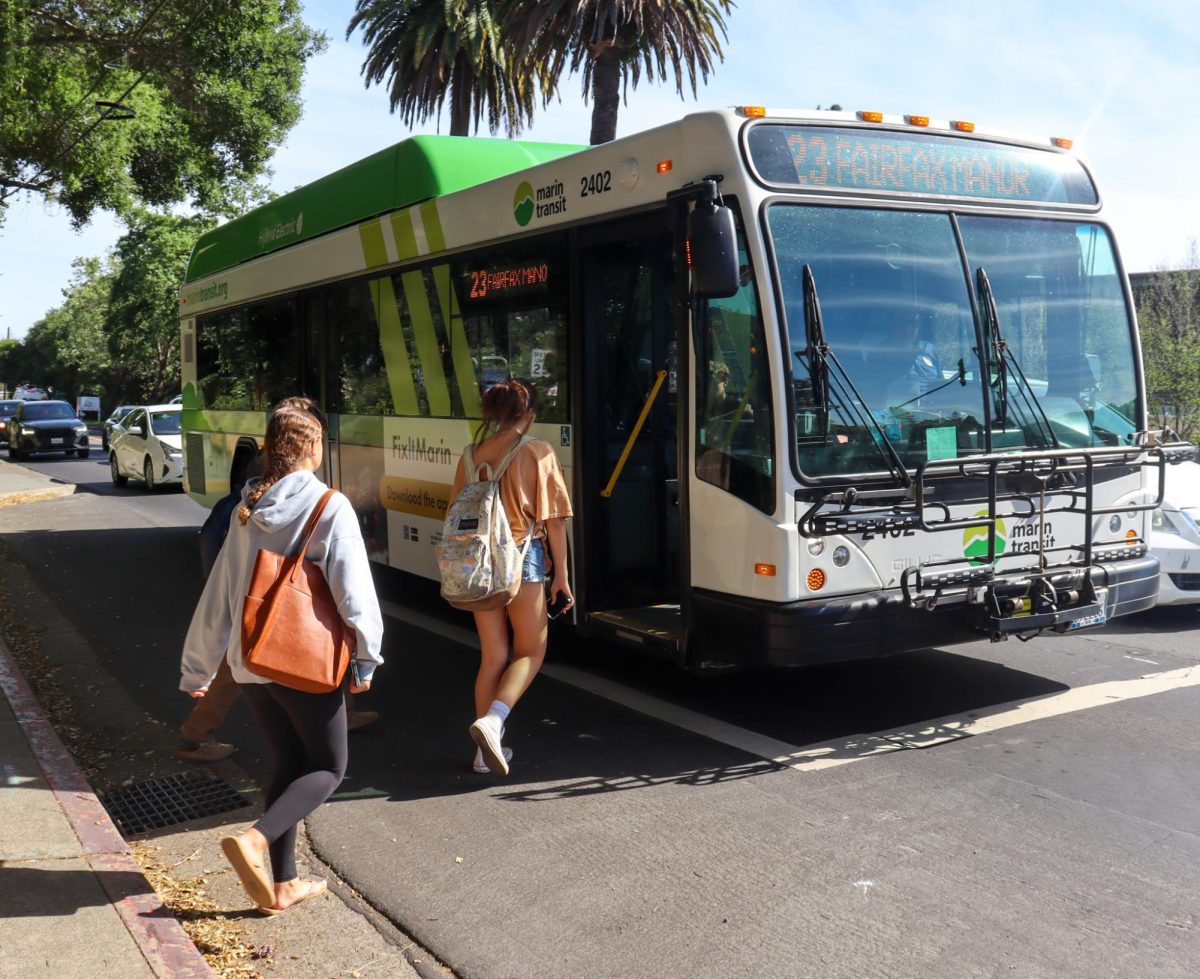
Marin County offers several public transportation options, including buses and trains. Public transportation can reduce carbon emissions if utilized regularly and can benefit individuals seeking efficient travel in their communities. As reported by the Public Health Action Guide, reliable and more accessible public transportation decreases the risk of traffic incidents and harmful emissions that cause lung issues. However, despite these benefits, public transportation remains unused by most students in Marin County.
Archie Williams assistant principal Nate Severin emphasized the importance of well-designed public transit systems, and explained how effective transportation can influence what people use to get around.
“Public transportation can help provide more efficient access to different places around where you live,” Nate said. “In other countries that have really good public transportation, it’s so good that it becomes the default because it’s quicker. If it is done properly, it can be more efficient. If it is not done properly, I would rather just drive my car.”
Marin Transit offers the Youth Pass, which allows Marin County students and youth under the age of 18 to ride local transit an unlimited number of times for free. Despite this, many students still choose not to use public transportation: In a survey, Safe Routes to School found that public transportation is unpopular among students in Marin, with only six percent of students arriving at school by bus.

Sophomore Tanner Lewis believes the students in San Geronimo Valley face problems when trying to rely on inconsistent public transportation times.
“I think more frequent bus times in certain areas could be greatly beneficial to the people that live there. For example, the bus stop in Forest Knolls and Woodacre only comes once an hour, sometimes longer because there are breaks in between the buses,” Tanner said.
For students without their drivers licenses, public transportation can make commuting easier, especially when travelling several times a day to and from school. However, participating in school commitments, such as sports, requires time-sensitive transportation. With irregular bus times and long gaps before arrivals, many students find it difficult to rely on public transportation without risking being late to sports or commitments.
“If you miss the bus, you have to wait for the next one, so I think it would be helpful to make more options for students and make those options financially reasonable or free, which would encourage students to use public transportation,” Severin said.
While public transportation has the potential to improve accessibility, its environmental impact is more complex. As stated by the U.S. Environmental Protection Agency, a typical passenger vehicle emits about 4.6 metric tons of CO2 per year. This highlights how individual car use significantly contributes to carbon emissions. In contrast, public transportation can reduce overall admissions by carrying many passengers at a time, but its effectiveness depends on how frequently it is used and how efficiently the system operates.
Marin County District 4 Supervisor Dennis Rodoni pointed out that public transportation also has environmental drawbacks because of the emissions buses create.
“Buses are actually the biggest polluters, because they used to run on diesel, polluting the environment. Now they run on bio-diesel, which is better. They run all day long, they’re really large contributors to that environmental damage,” Rodoni said.
However, data from the United States Environmental Protection Agency shows that the reality is more complex. While diesel food can create around 15 percent more CO2 per gallon than gasoline, diesel vehicles often achieve higher fuel economy than similar vehicles that use gasoline, which generally offsets the higher carbon content of diesel fuel. This shows that the environmental impact of buses depends on factors like fuel type, efficiency, and number of riders.

Choosing buses or trains instead of individual vehicles could significantly reduce Marin’s carbon emissions. However, this depends on how efficiently operators use the system. Although public transportation can reduce emissions when widely used, large vehicles that run with few passengers may end up contributing more to Marin’s carbon footprint than they reduce.
“Marin has been built as a single-vehicle community for many decades, and while single vehicles have a major impact on our environment, the alternative public transportation doesn’t meet the residents’ demands,” Rodoni said.
Marin’s public transportation system is working to reduce and improve its environmental impact. The federal government awarded the Marin Transit company a 5.46 million dollar grant that will allow them to invest money in zero- and low-emission buses. In addition, a broader push is underway to transition to electric buses.
“There’s a big push to change most of the bus system to electric. That’s supposed to happen by 2035 […] In April, they are going through some transitions where all public bus transportation will get together and try to align their schedules so they are not duplicating routes and that they are actually providing more service to people that need it,” Redoni said.
Introducing more routes and adjusting schedules to better fit students’ school hours could encourage students to use public transportation. While public transportation in Marin County has the potential to reduce emissions and expand accessibility, increasing its usage and efficiency will be key to making it a truly effective alternative to driving.