
Dr. Jane Goodall, a pioneering ecologist and lifelong environmental activist, transformed the world’s understanding of chimpanzees and inspired global conservation efforts. Her work throughout the late 20th century in Gombe National Park led to revolutionary changes in humans’ knowledge of chimpanzees and animals around the world. Even after her passing on October 1, 2025, Goodall’s message of compassion, awareness, and action continues to inspire new generations to protect the planet.
Goodall grew up in England at a time when constraining gender norms forced young girls to fit a specific image of what a perfect lady should be. Nevertheless, from a young age, Goodall pushed against these stereotypes. Her fascination with animals led to her interest in zoology and ecology in high school, as she aspired to visit Africa to observe animals in their natural habitats.
Richard Wrangham, a Biological Anthropology professor at Harvard and Goodall’s former mentee, believes her calm demeanor reflected her quiet authority and thoughtful nature.
“She tended to speak quietly in a measured way that indicated she was taking her own thoughts seriously, and expected her companions to do so too. So at the same time as being friendly she was mostly very composed, which meant that she came across as slightly reserved. I was younger than she was, like all the research assistants and students in Gombe, so I think she made sure to behave in a way that ensured she kept her authority,” Wrangham said.
According to Wrangham, Goodall’s diligent work ethic was balanced with a more personable and funny personality when with friends.
“In later life she met enormous numbers of people who wanted to be associated with her, and I saw her handling them brilliantly with a combination of almost regal politeness and occasional much more personal remarks,” Wrangham said. “When she was relaxed, however, she could ‘let her hair down’ in a charming way, giggling and making silly comments, or unreservedly sharing her passionate interests.”
However, Goodall’s dreams of becoming an ecologist came to a halt when she realized she couldn’t afford university. Nevertheless, she worked hard as a secretary at Oxford University to finance a trip to Kenya in 1957. In Kenya, Goodall sought out the famous paleoanthropologist Louis Leakey, who quickly hired her as his secretary, recognizing her work ethic, drive, and attitude.
After five years working under Leakey, Goodall was sent to the Gombe Stream National Park in Tanzania to observe the behavior of chimpanzees. Goodall studied with chimpanzees for two years, earning their trust, and soon, was welcomed into their community. While Goodall’s discoveries were groundbreaking, countless scientists dismissed Goodall’s belief that chimpanzees had emotions and deserved individual names, a perspective that challenged traditional research.
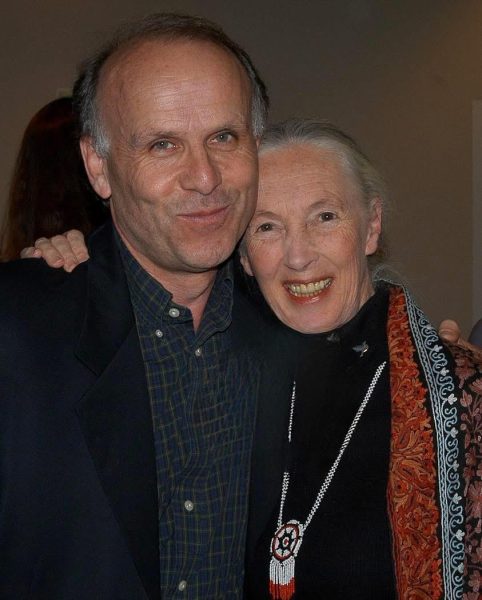
“[Goodall] was severely criticized. She had never gone to college, she had worked as a secretary to make money to go to Africa… She had huge obstacles to overcome, but she was very insistent,” said Professor of Ecology and Evolutionary Biology at the University of Colorado Boulder and close colleague of Goodall, Marc Bekoff.
Goodall’s turning point from scientist to activist was in Chicago during a primatology conference in 1986. Her peers expressed their worries about deforestation in Africa, and Goodall recognized the need to initiate a global change. In 1991, she founded Roots & Shoots, a program aimed at helping younger generations fight for change in their communities. Goodall launched Roots & Shoots through her sister non-profit, the Jane Goodall Institute, her primary platform.
“[The Roots & Shoots’] major goals are to increase respect for animals, people, and the environment. It’s been really influential, especially getting young kids to do the things that they need to do to make the world a better place… the values you grow up with and you develop when you’re young, the hope is that they will stick with you through your life,” Bekoff said.
Much like the Roots & Shoots program, the Jane Goodall Institute works on protecting the environment and every organism that lives in it. The institute continues to work on the research that Goodall started in the 1960s, while also focusing on more community-based initiatives: the Jane Goodall Institute campaigns for chimpanzees to stay wild and the truth behind chimpanzee trafficking.
Through these programs, Goodall was determined to emphasize that everyone can make a difference, and it’s crucial to protect the environment. She urged everyone to protect the planet for future generations and inspired others through the Jane Goodall Institute and Roots & Shoots.
“She had many important messages [like] ‘What you do makes a difference, and you have to decide what kind of difference you want to make,’” Wrangham said.
The influence of Goodall’s environmental activism is also apparent in the Archie Williams community. Social and Environmental Academy-Dedicated to Improving School and Communities’ (SEA-DISC), a learning community at Archie Williams shares a message of environmentalism with the Roots & Shoots program. By encouraging students to think critically about their impact and to take initiative in their communities, SEA-DISC mirrors Goodall’s belief that change starts with awareness and compassion.
Clarke Bugbee, a SEA-DISC and AP Environmental Science teacher at Archie Williams, believes in the importance of understanding how individuals can counteract these harmful effects on the environment.
“We’re always talking about human impact on the environment… with the hope that we can learn to minimize our impact through learning what we are doing… knowingly or unknowingly to the environment,” Bugbee said.
Local Marin non-profit organization WildCare embodies Goodall’s respect and dignity for the environment through their aid of animals in their wildlife hospital and teachings about animals through a nature education center. Like Goodall, WildCare strives to teach community members about what they can do to help animals in their area. Her message of community-driven activism remains a powerful source in Marin County. WildCare Head of Communications Alison Hermance emphasizes the importance of community involvement in their programs and overall mission.
“Our Nature education programs are inspired and informed by the work that happens in the wildlife hospital, and we reach about 15,000 children and adults through our nature education programs every year. The idea of what we teach in the education programs is to prevent the harm to animals that we see happening in the wildlife hospital, whether that’s protecting habitats or teaching people not to litter,” Hermance said.
In 2013, WildCare honored Goodall with its Environmental Award, given to individuals or organizations that make major contributions to animal welfare, conservation, and environmental protection. Goodall was recognized for her leadership and her close alignment with WildCare’s mission of fostering human and animal coexistence.
“She’s not going to be forgotten in that sense… We really want to keep her [legacy] alive,” Bekoff said.
Goodall’s story brings hope and possibility to thousands of women and scientists who want to follow in her footsteps. A children’s book by Goodall and Bekoff will be available for purchase in 2027. Though she is gone, Goodall’s voice and legacy continues through those who take action and care for the planet.