




On Oct. 14, 2025, the Marin County Board of Supervisors unanimously approved a 266.6 million dollar bond to fund the renovation of Golden Gate Village, a historic public housing complex in Marin City. The long-awaited project will unfold in multiple phases over the course of several years.
Golden Gate Village serves as Marin City’s only family public housing site and comprises nearly 300 rental units across 29 buildings built between 1957 and 1961.
“Everybody is excited [about the renovations], it’s been what, 60 years?” said Scott Joo, a three-year resident of Golden Gate Village. “In the picture, the [renovations] looked good, very fancy, like a modern apartment, so everybody is satisfied. They definitely need [the renovations] to better the life of tenants physiologically and mentally.”
The Marin Housing Authority (MHA) owns and operates Golden Gate Village, overseeing the renovations. Planned renovations include complete kitchen and bathroom remodels; upgraded, energy-efficient heating, ventilation, plumbing, and electrical systems; roof replacements; and additional sustainability improvements designed to enhance residents’ health, safety, and long-term quality of life. Kimberley Carroll is the executive director of the MHA.
“We manage those 300 units, and Golden Gate Village is 300 units of family public housing. Public housing is owned and managed by [the Department of Housing and Urban Development] and the Housing Authority. We do all of the lease-up, property management, and maintenance for Golden Gate Village,” Carroll said.
The revitalization will occur in three phases, each focused on renovating approximately 100 units.
“We’re doing [the revitalization] in three phases, because it’s 300 units, and we’re going to have to relocate people for up to four months while the renovation gets done. We hope that all three phases will be done within five years [and] we’re closing in on the first phase in early 2026… A lot of people will move to another vacant unit within Golden Gate Village while their unit’s being renovated,” Carroll said.
The MHA Board of Commissioners — a seven-member board including five members appointed by the Marin County Board of Supervisors and two residents within the MHA — developed the revitalization plan in November 2022. The MHA has long sought to renovate Golden Gate Village.
“This is a really huge milestone and success that we were able to renovate these homes because it’s time; they were built in 1960, and there’s not been a lot of money from the federal government to update them,” Carroll said. “We’ve been working on [making the renovations happen] for over 10 years, and it’s been very hard to make it work for all kinds of reasons.”
Architect Aaron Green and landscaper Lawrence Halprin designed Golden Gate Village. Green was a protégé of Frank Lloyd Wright, a renowned American architect credited with creating over 1,000 structures during his career, including the San Rafael Civic Center. On Sept. 18, 2017, the National Register of Historic Places recognized Golden Gate Village as a historic site, deeming the property worthy of preservation and eligible for federal government financial incentives.
According to the Golden Gate Village Resident Council, “The primary intention [after the Village’s completion] was to provide housing for Black shipyard workers who had been employed at Marinship in Sausalito during World War II but were prevented from buying
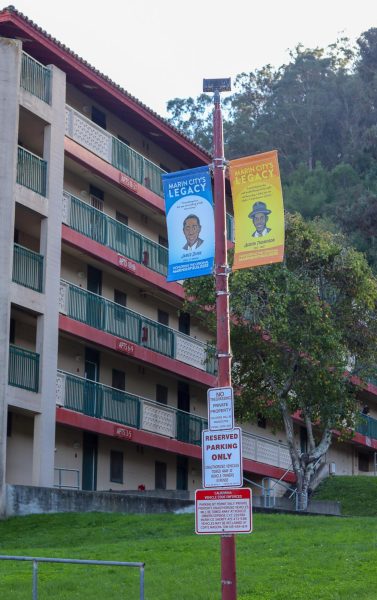
homes in Marin County after the war due to restrictive covenants and redlining.”
Historically, discriminatory policies and restrictive covenants that prevented people of color from purchasing homes have been illegal in the United States since 1968, with the passage of the Fair Housing Act. However, despite the restrictions on discriminatory housing policies, the legacy of redlining has shaped the Bay Area as it looks today.
The term “redlining” originally referred to the practice of marking federal zoning maps with red lines to identify neighborhoods deemed too risky for mortgage lending. Uncoincidentally, these neighborhoods, deemed a “risky investment,” often housed communities of color.
Archie Williams AP United States History (APUSH) teacher David Gutfeld incorporates redlining into his APUSH curriculum, aiming to educate students about the connection between discriminatory housing practices and broader systems of racism and inequality in the U.S. Gutfeld believes that there are deeper lessons in studying redlining beyond labeling it as “bad.”
“We here in the Tamalpais Union High School District (TUHSD) do a really nice job with our Ethnic Studies curriculum, redlining is pretty well taught,” Gutfeld said. “So now there’s the question of, ‘what was the actual lesson?’ Is it racial segregation, or is there something deeper to learn from it?”
Gutfeld connects this lesson to his own experiences, observing similar patterns of exclusion in his daily life.
“I drive [to work] every day over the Richmond Bridge with construction workers, with doggy daycare workers, with pool workers, and other types of workers like myself because they can’t afford to find housing [in Marin]. So how are they being excluded? It’s not the same as redlining, but it’s still the same process of socioeconomic exclusion,” Gutfeld said.
Crystal Martinez, an aide to Marin County Supervisor Mary Sackett, participated in researching the history and prevalence of restrictive housing covenants in Marin. These covenants were clauses in property deeds that prevented specific groups of people from purchasing, leasing, or occupying certain properties. This research culminated in the creation of the Restrictive Covenant Project in May 2021, an initiative aimed at educating the public about the past, with a focus on the role that racially discriminatory covenants played in shaping Marin County’s communities. Martinez first became involved in the project while serving as an aide to District 2 Supervisor Katie Rice.
“I got involved with [the Restrictive Covenant Project] at its start. I first began as an aide working for Supervisor Rice in District 2,” Martinez said. “Supervisor Rice lives in Sleepy Hollow and was looking at her property documents and noticed a racially restrictive covenant in her own property document, and was horrified, like many other folks at the time.”
In response, what began as a small intern-led project to create an educational library page on redlining and restrictive covenants grew into a multi-year effort to develop a curriculum on Marin’s discriminatory housing history. Eventually, a three-day curriculum outlining the history of restrictive covenants in Marin was established.
“I had some interns over the summer who were really interested in helping me build a library page to help educate folks about redlining and restrictive covenants in Marin County. We spent the next few years building a curriculum that’s now being taught in some high schools,” Martinez said.
The goal of the curriculum is to teach the historical facts of redlining and restrictive covenants and encourage reflection on the ongoing impact of such policies. Martinez framed the project as a way to highlight how these practices excluded people from housing in Marin.
“Part of educating folks in Marin County about the restrictive covenants was to show them that so many people have lacked access to housing and entry points into Marin County,” Martinez said. “This is our opportunity as a community to reflect and look at how we can be more creative and inclusive in our housing policies.”
Although the curriculum was not implemented at all schools throughout the TUHSD, the committee ensured that the content remained accessible digitally. The effort reflects a growing push to understand how restrictive covenants shaped conditions in Marin. As renovation plans progress at Golden Gate Village, the ongoing reflection on the County’s history provides context for the conversations surrounding Marin’s housing landscape today.