
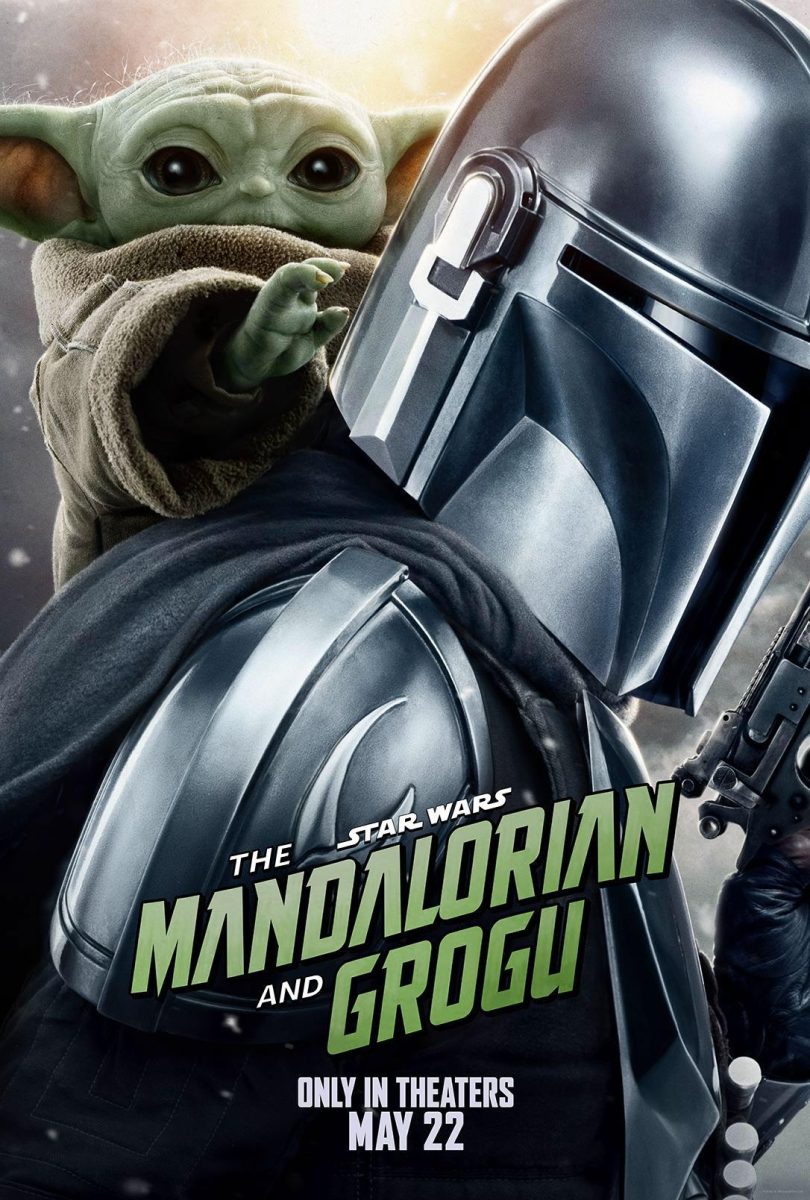
There is an especially telling moment roughly 30 minutes into Star Wars: The Mandalorian & Grogu, the feature film continuation of the beloved Disney+ series, The Mandalorian. In this scene, Grogu, a green, doe-eyed creature of young age and indeterminate species, extends his tiny hand and causes an object to move across the room with nothing but his mind. Throughout the theater, viewers laugh and gasp as Grogu appears on screen, accompanied by heavenly background music that erupts into a fascinating symphony that contradicts Grogu’s childlike appeal. However, sitting in the dark, one can’t help but wonder: How has Lucasfilm perfected the science of creating amazement?
The first Star Wars movie in seven years, Star Wars: The Mandalorian & Grogu finally arrived in theaters Friday, May 22. Star Wars: The Mandalorian & Grogu follows the Mandalorian bounty hunter Din Djarin (Pedro Pascal) and his apprentice Grogu, a Yoda-like creature. Fans of the show will feel right at home. Even for newcomers, it’s not necessary to understand the simple plot that follows these two protagonists along their journey through the outer reaches of space.
New Republic Colonel Ward (Sigourney Weaver) tasks the Mandalorian and Grogu with a critical mission to hunt down Imperial Remnant forces and gangsters in the dangerous Outer Rim territories to protect the fledgling Republic. Weaver commands every scene and brings back a dominant presence that the late Carrie Fisher’s Princess Leia fully embodied. However, she immediately disappears, sparking debate among fans.
Directed by Jon Favreau and with a runtime of two hours and 12 minutes, Favreau’s big screen adaptation feels less like a movie and more like a few shows stretched past their limits. The pacing strays away from its television origins, stretching out a single fight into an hour-and-a-half-long slog while allowing scenes to linger and side characters to appear and disappear as if they wandered onto the wrong movie set.
Composer Ludwig Göransson wields an ominous yet soothing soundtrack, highlighting key points with ethereal vocal choirs and sweeping orchestral tones, allowing powerful moments to hit on a deeper level. Göransson helped bring an emotional depth that the series generally lacked, as its episodic format made it difficult to build a sustained sense of connection.
Pascal, despite being buried beneath a sheath of Beskar steel for the majority of the film, remains an emotional anchor. Star Wars: The Mandalorian & Grogu shows the Mandalorian’s tangible care towards Grogu, giving a soft undertone to what is otherwise a battle-driven story. Pascal communicates through posture and pause, often bypassing facial expressions and falling back on the archetype of masked Lucasfilms characters. Yet, he carves out a new type of category, one that isn’t dominated by darkness and non-emotive characters like Darth Vader, Boba Fett, and Darth Maul.
Grogu, of course, needs no defense. He’s engineered for adoration and awe and succeeds effortlessly. Along his journey, miniature, gibberish-speaking mechanics known as Anzellans accompany him and provide major comic relief, spewing out frantic comments and unexpected one-liners. The little characters are amusing to the audience, but utilize childlike humour that creates a far too lighthearted atmosphere for the dire consequences the characters consistently face throughout the film.
For three seasons, Din Djarin remained an emotional fortress. In the late stages of the film, however, we see his humanity for the first time. The cinema went silent as the fierce warrior’s life fell into the hands of Grogu, a 50-year-old toddler who resembles a mutated baked potato. Had this vulnerability been sprinkled throughout the seasons, these overwhelming emotions would not have clouded the film’s plot.
The Mandalorian and Grogu movie isn’t a transformative shift from the television series, but rather a wave of culture shock that emerges after the man who never takes off his helmet is forced to do so. While epic fight scenes cement the film, the Mandalorian’s sudden dive into unexplored emotions slows its momentum. Star Wars: The Mandalorian & Grogu is not so much a disappointment as it is a deferral, promising compelling character development in the future while presenting an onslaught of emotional change in the present. Consequently, the film earns 3.5 out of five feathers.