
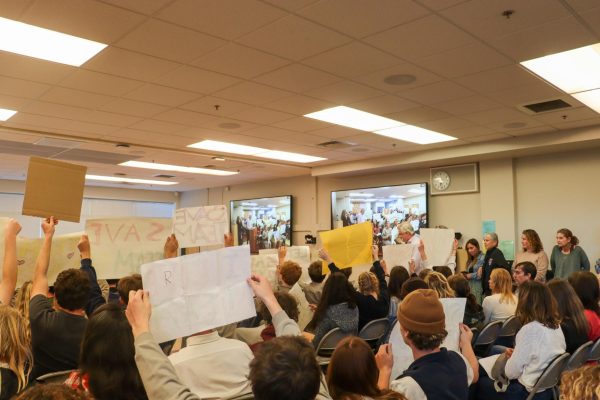
On Thursday, March 5, Principal Jacob Gran announced via email that the Archie Williams TEAM Academy will return to a seniors-only structure in the 2026 to 2027 academic year; the current junior class will move up to complete the program and no new junior cohort will be admitted. Principal Gran made this decision to allow students to better balance the required curriculum with the TEAM program’s numerous out-of- school commitments. On Tuesday, March 10, TEAM members gathered at the Tamalpais Union High School District (TUHSD) board meeting at Redwood High School to protest the change, urging the district to protect the program and its positive impact on the Archie Williams community.
TEAM was originally founded as a one-year program at Tamiscal High School in 1990, where it operated for nearly two decades. After a brief hold in 2018 due to the COVID-19 pandemic, TEAM was reestablished at Archie Williams in 2021 and has been operating with blocked schedules and a two-year structure of 26 juniors and 26 seniors.
It is one of two current Archie Williams academies, the other being the Social and Environmental Academy Dedicated to Improving School and Community (SEA-DISC). Academies are programs that combine core curriculum classes with education in specific areas of focus. TEAM offers classes in wilderness medicine, student leadership, and workplace learning.
As an “experiential learning model,” TEAM fuses project-based learning with hiking, backpacking, rock climbing, community service, internships, and field medicine. The goal of the academy is to provide students a space to reconnect with themselves and the world around them, to participate in their community, and to foster close-knit relationships with
their peers in their cohort.
Principal Gran described his decision to return TEAM to a one-year program as a measure to support the long-term stability of the academy. In his email sent out to students and parents, he said the cut would address concerns about the missed curriculum for its members.
“A key factor in this decision is the amount of instructional time students miss in a two-year model due to extended field experiences. While these experiences are valuable and central to TEAM’s mission, they also require students to be out of class for multiple weeks each year,” Gran wrote.
Later, Gran also expressed concern regarding the assets necessary to keep the Academy running sustainably.
“TEAM has always required additional resources to facilitate the programming,” Gran said. “[This change] is to help sustain the program long-term and ensure that the same number of students continue to have access to the program.”
Unhappy and confused with the decision to change the structure, TEAM members, parents, staff, and prospective underclassmen gathered at the March 10 TUHSD board meeting to protest the change. They described the decision as unexpected and that it was announced before any communication with the teachers and students involved in the program. Many speakers expressed their concerns about the two-year structure being essential to TEAM’s essence, mentorship model, and community culture. The academy’s primary instructor, Diana Goldberg, stated that the decision was made without input from those running the program.
“This time, the decision and model was made without us, and we do not believe it can run in the school well or long term,” Goldberg said. “We are being told this new model will be most sustainable without any evidence to back up these claims or a seat at the table to make the changes.”
TEAM currently operates with 1.4 full-time equivalent (FTE) staff positions across two teachers, but the new model reduces that down to 0.8 FTE positions, which will require instructors to teach classes outside of the program, as well as organize and coordinate TEAM trips and outdoor programming.
“TEAM ran as a one-year model at Tamiscal for 30 years. This model is nothing like what is being proposed. That model had two full- time teachers and just juniors at an alternative campus all day every single day,” Goldberg said. “The job is almost impossible not to have a full-time teacher running it.”
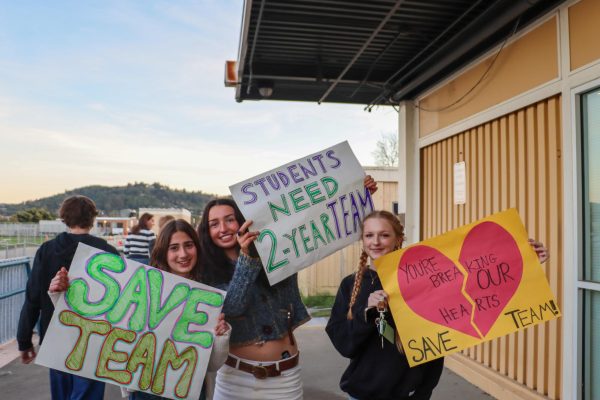
Students are especially upset about the potential loss of the TEAM community and mentorship that makes the program unique. Senior TEAM member Zara Prime highlights how the cycle of guidance and shared experiences is what makes being a part of TEAM meaningful for herself and her peers.
“It’s about that connection between the two grades, about being a leader, learning from the seniors your first year, and then becoming the mentor in your second,” Zara said.
Jacob Gran acknowledged the deep and meaningful connections students have to TEAM in the original email and stated that counselors will be in contact with sophomores who had planned to join the academy next year to adjust their class schedules.
“We recognize that this program is deeply meaningful to many students and families, and we remain committed to preserving the core experiential learning, leadership development, and community that make TEAM such a special part of our school,” Gran said.
Students and staff hope that the future of TEAM can continue to function in a manner that preserves its core values, and that the district will work with staff and the community to find a sustainable path forward. At the board meeting, several students and parents shared speeches sharing how TEAM has impacted them, appealing to the board members to keep the program running as a two year model.
“I urge you to remember what it is to be a young student, and what it is to feel belonging,” Zara said in her speech. “This program has transformed the lives of hundreds of students, and I hope with all my heart that it can continue to do so.”