

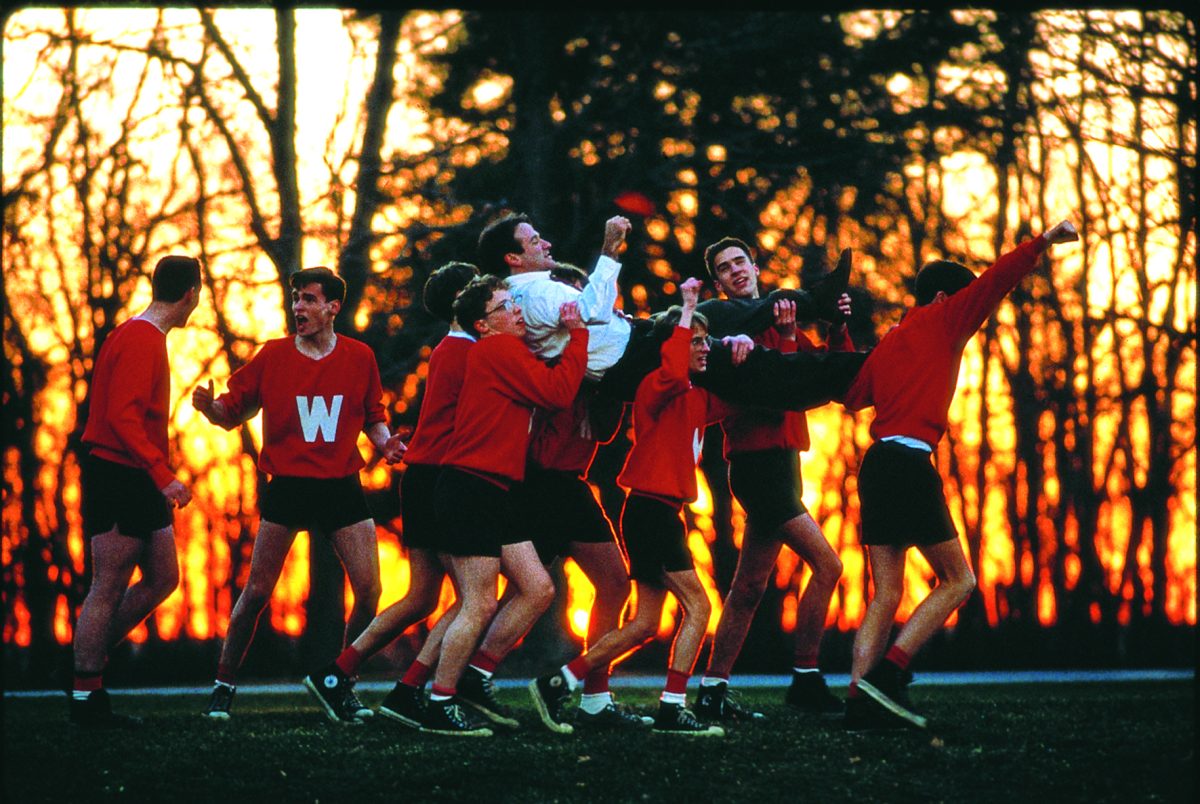
On June 2, 1989, Dead Poets Society premiered as a heartbreaking story about limits and societal expectations. 36 years after its release, the film remains a timeless classic due to its portrayal of living life to the fullest and fighting for freedom from stereotypes. Caution, spoilers ahead…
American screenwriter Tom Schulman wrote the original screenplay for Dead Poets Society, and much of the movie’s plot was inspired by his own boarding school experience, including savvy English teacher, John Keating (Robin Williams).
Located in Vermont, the fictional school of Welton holds four pillars of honor, tradition, excellence, and discipline. These rules become threatened when the school headmaster, Gale Nolan (Norman Lloyd), hires Welton alumnus John Keating, who believes his students should have fun and fulfill their lives with their passions instead of conforming to norms.
Williams, typically recognized for his comedic film roles, stepped outside his comfort zone to portray Keating, a more serious and introspective character.
While the acting throughout the movie is generally good, the thoughts behind Keating’s teaching ways are debated. He goes against the school and its beliefs on how to teach and reprimand, but although Keating puts his own spin on it, he tells his students throughout the movie to do what they want, though he was hired for the opposite.
As a teacher and a mentor, Keating is a revelation to the Welton boys. His students crave the unfamiliar message he teaches. The film features Neil Perry (Robert Sean Lenord) and Todd Anderson (Ethan Hawke), who are assigned as roommates at Welton. Neil, a lively individual, is paired with Todd, the film’s protagonist —a shy and sheepish character. Neil and Todd hit it off and form an unlikely bond.
Neil then introduces newcomer Todd to the other boys on the floor, creating a friendly group atmosphere. This is strengthened when the boys find a yearbook from the year that Professor Keating attended Welton and discover mysterious evidence of a so-called secret society at the school, the “Dead Poets Society.” When the boys question Keating he confirms the society’s existence, inspiring the boys to revive the club. “We didn’t just read poetry–we let it drip from our tongues like honey. Spirits soared, women swooned, and gods were created,” he says.
Keating’s teachings and the bond of the Dead Poets Society give each member more confidence in every aspect of their lives.
Neil, an avid rule follower with strict parents, is also shaped by Keating’s advice. Neil disobeys his father and joins an extracurricular acting production, embracing a newfound sense of bravery in the process.
As a result of his courage, Neil ends up earning the lead role. For weeks, he keeps his involvement in the play a secret from his father, until the day before the show, when his dad (Kurtwood Smith) finds out and confronts Neil about the production.
Neil defies his father’s wishes and stars in the show anyway, proving to be a gifted performer. After arriving home, Neil’s father informs him that he will be unenrolling him from Welton and placing him in a military academy for going against his advice. Not out of defiance, but instead resignation, Neil takes his own life, not wanting to live up to his father’s expectations. Keating is fired when both the school and Neil’s parents hold him responsible for Neil’s death.
The ultimate decision of Neil’s taking his own life is a dark fate of, as it felt, one singular conflict. It seemed as Neil’s mental health had declined from one hundred to zero in the span of minutes, which looking back, felt quite extreme and almost too quick for a movie plot. There was no slow burn of emotion, instead a quick burst of intensity.
Todd, Neil’s closest friend and roommate, stands up to the school’s unjustified treatment of Keating, both literally, by standing on his desk, and figuratively, by declaring that Keating was not in the wrong. Todd’s message is not only welcome, but valued and respected by his peers, inspiring classmates to do the same and rebel against restrictive Welton traditions.
The acting feels raw and emotional, throughout Dead Poets Society, creating a must-watch experience for students, people with passions, parents, those who have ever felt the weight of societal expectations, and individuals who haven’t felt free, all of whom want to “seize the day.” The movie’s themes, specifically of breaking societal expectations and stereotypes, and pursuing passions, while perhaps not as overt today as they were at Welton Academy in 1959, are still moving.